

Creating Effective Rubrics for Standards-Based Grading (SBG)
I like writing rubrics. Really. There are a couple of reasons for this crazy assertion. Rubrics give students a very clear set of criteria to help them demonstrate their learning. They also help me as I assess student work – rubrics focus my attention on what to look for in student submissions, and remind me that the things I’m looking for are the things I (should have) taught in my lessons.
This focus on what was taught and what students were expected to demonstrate supports my endeavor toward equitable grading practices. So, in the end, creating a well-designed rubric is a concrete manifestation of my attempt to be an equitable practitioner. It’s the actualization of a portion of my teaching philosophy. I’ll add that I also like writing rubrics because creating a good one is hard to do. When I finally get it right, having created a good rubric feels great.
Steps for Successfully Building and Creating Rubrics
The first step I take in writing a rubric is determining what the students are meant to learn. If the learning demands higher order or critical thinking, a rubric is a good assessment tool. Likewise, a rubric is a helpful assessment tool if the learning will result in the application of skills. For a reference for higher-order thinking and application of skills, look at the latter four columns on the first page of this version of Bloom’s Taxonomy.
In addition to considering the type of thinking demanded by the learning, teachers should also consider the types of products students will create. Rubrics are useful tools for assessing extended writing, speaking/presenting, exhibiting a skill, or a multi-faceted project that demands things like information synthesis and organization (think slide deck, podcast, poster).
Part of zeroing in on what the students should learn is being able to name the performance indicator (PI) or long-term learning target (LTLT) the assignment is meant to assess. It is reasonable for a single assignment to assess more than one PI or LTLT, but avoiding the kitchen sink model is important. For a refresher on PIs and LTLTs, look at Moving from Standards to Targets.
Think very carefully about the PI(s) or LTLT(s) you intend to assess:
-
- Will you teach these PIs or LTLTs prior to assessing them?
- Will you assess all components of those you have chosen or portions of them?
Let’s look at an example from Common Core State Standards, 7th grade Writing. In the example, “Write arguments to support claims with clear reasons and relevant evidence,” we see several choices for what to assess. We might choose to focus initial instruction, and therefore assessment, on claim, reason, and evidence and subsequent instruction and assessment on the entirety of argument writing.
Write arguments to support claims with clear reasons and relevant evidence.
CCSS.ELA-LITERACY.W.7.1.A
-
- Introduce claim(s), acknowledge alternate or opposing claims, and organize the reasons and evidence logically.
CCSS.ELA-LITERACY.W.7.1.B
-
- Support claim(s) with logical reasoning and relevant evidence, using accurate, credible sources and demonstrating an understanding of the topic or text.
CCSS.ELA-LITERACY.W.7.1.C
-
- Use words, phrases, and clauses to create cohesion and clarify the relationships among claim(s), reasons, and evidence.
CCSS.ELA-LITERACY.W.7.1.D
-
- Establish and maintain a formal style.
CCSS.ELA-LITERACY.W.7.1.E
-
- Provide a concluding statement or section that follows from and supports the argument presented.
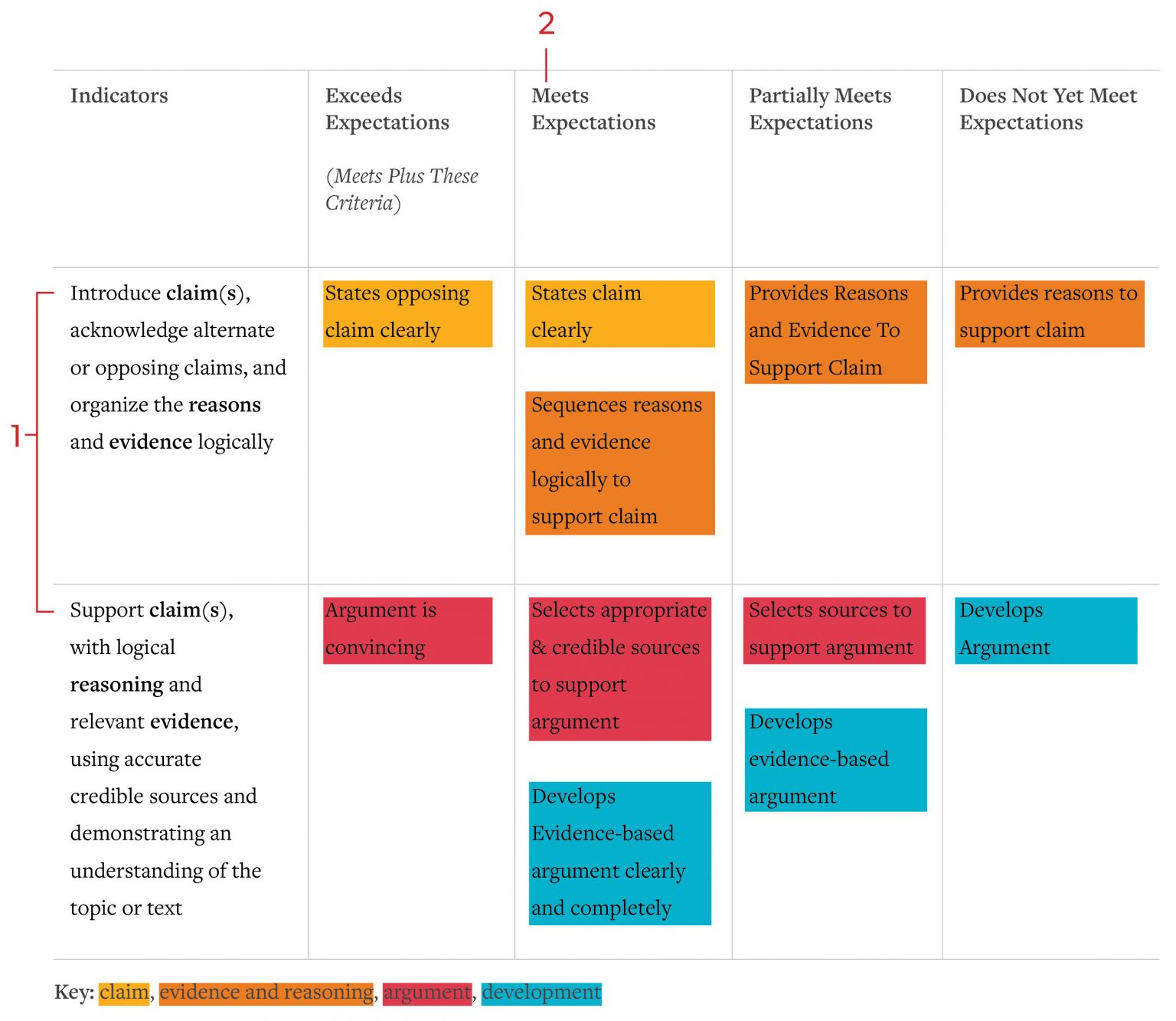
Once you have figured out what you would like to assess, indicated below with (1), determine the rigor level at which you should assess, indicated below with (2). A note for JumpRope users here: in cases where you are working with the district-level edition, your rigor levels have already been established. In this case, you might use those rigor levels verbatim for your rubric, or you might derive from them assignment-specific language in creating a rubric.
Some of my favorite resources to help determine rigor levels are Bloom, Webb, and Marzano. I use these tools to write the Meets Expectations column first, as that is the column indicating precisely what the students need to demonstrate. From there, you can determine Exceeds or Partially Meets, whichever feels easier to write at that moment. The goal is to look for different levels of thinking that all address the indicator or target.
Two cautions regarding rubric development: it is tempting to use language like “always,” “mostly.” and “sometimes” or to specify quantities (like 3 paragraphs, or 2 sources, etc.) Try to keep in mind that we are assessing thinking. There are cases where quantity is what we are looking for, but always ask yourself if that is indeed the case. For example, in learning to find sources, if a student finds two highly relevant and reliable sources for their research, their work is likely to be better than that of the student who finds four irrelevant or unreliable sources.
The example below is my attempt to show how I address varied levels of thinking in each column. Note that the columns describe what a student would include or do, not what they would omit or leave out.
A Journey in Helping Students Succeed
In my many years of learning to write rubrics, I have come to see that they involve both science and art. I realize that to help my students succeed with the learning goals I set before them, they need to know what success looks like.
The science comes in when I take the time to think very carefully about what I would like them to learn and demonstrate. The art is in how I craft the tool that will support them in this process, and the instruction and learning experiences I design to help them utilize that tool.
If you’d like to learn more about how JumpRope can help you build and create rubrics for student success, reach out today for a discussion.