

Proficiency Scales Defined
A proficiency scale is a continuum with scores and descriptors that provides a concrete and theoretically objective measure of learning (Turner, 2014). Learning metrics like scales enable educators within a system to know more clearly what learning should and actually does look like. A scale helps teachers plan for instruction, enables teachers, students and parents to mark progress, and supports teachers and students in setting personalized learning goals (Turner, 2014). In short, proficiency scales help everyone involved in the process of school-based learning see the goals for the intended learning and measure the results of said learning.
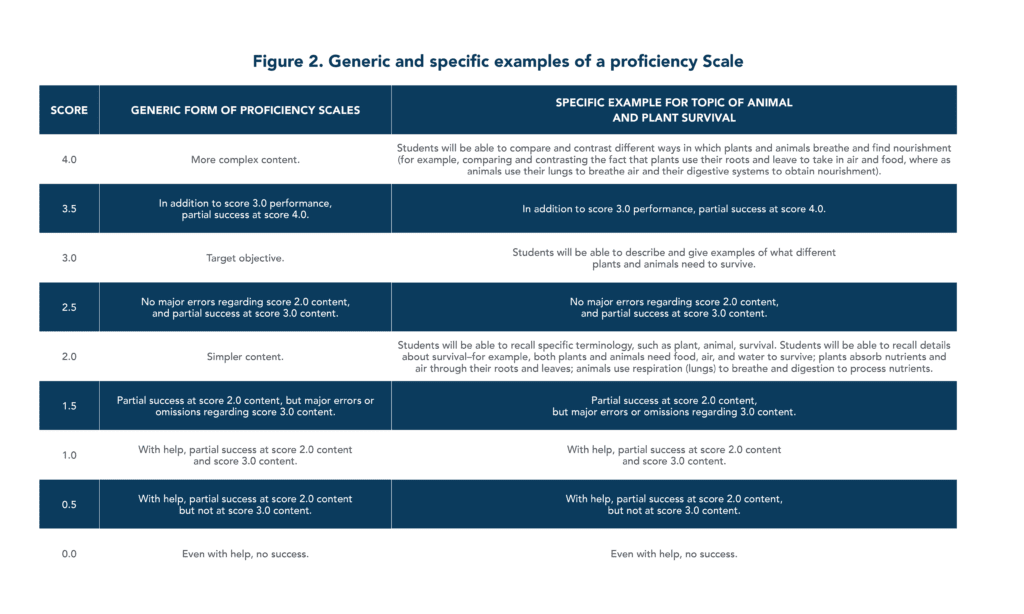
There are various graphic representations of proficiency scales. Marzano & Hefflebower (2007) provide a clear example of a vertical scale that matches task-specific applications for assessment and grading to general levels of attainment. In their example, we see in the lefthand column the general descriptors for the anticipated progression of learning and in the righthand column the more finely tuned and clearly delineated expectations for this dedicated learning target.
Another graphic representation of a learning scale is stars and stairs. I first saw the stars and stairs version of a proficiency scale, largely used with younger students in K-5 classrooms, in Jan Chappuis’ work (2012). In this version, rather than the scale being represented vertically, as depicted by Marzano & Hefflebower, it is shown as a staircase. Each new or next level is shown one step higher than the previous step, with the assessor using a star to indicate where on the staircase the student is. Stewart McCafferty & Beaudry (2018) provide a range of examples of this model. Here is one to help you visualize.

An analytic rubric is also a version of a proficiency scale. An analytic rubric is a grid with targets or indicators typically displayed on the leftmost column and a row of immediately adjacent specific descriptors, much like the descriptors in the above two examples. Here is a rubric created by one of my former students, Jen Macaluso, Mathematics. 8th Grade. Geometry: Transformations and Angles.

In a JumpRope 2024 series on rubrics I explain analytic and holistic rubrics as well as checklists and I take a closer look at each. In the series, I don’t explicitly name the analytical rubric or the criteria used for scoring as a type of proficiency scale, but they are. It seems the graphic representation of a proficiency scale in rubric form is more common than most other forms. Their use is widespread in standards-based and even more traditional classrooms, and is increasing.
The interest in the potential benefits to using rubrics has grown steadily since the turn of the century. The year 1997 saw the publication of the 100th paper mentioning assessment rubrics while in 2005 that number was up to 1000, and by 2013 the 5000th paper mentioning rubrics was published (Dawson 2017).
How to Use Proficiency Scales
While proficiency scales offer teachers a pathway to more objective summative assessment, their benefits are perhaps most keenly observed as they are employed through formative assessment. Through her metaanalysis of 17 studies of rubrics and other criterion-referenced scoring tools, used to make recommendations for classroom teachers and school administrators, Brookhart (2024) discovered a variety of such uses. Those included using them as a means to share criteria and work purposefully toward it; creating a framework for instruction; guiding group and individual work; framing self, peer, and teacher feedback; and self-diagnosis for improving work. In the most successful use cases, the criteria were introduced early in the learning or assessment process, students were familiarized with the criteria and performance descriptors, and given opportunities to use them.

Why Use Proficiency Scales
Proficiency scales and the different visual manifestations of them, offer students transparency and clarity, and therefore a sense of purpose and control. This can lead to increased student engagement and accuracy in self-assessment.
In their comprehensive meta-analysis, Panadero et al. (2023) confirm that academic performance is improved through the use of rubrics and that student self-regulation strategies and self-efficacy are also enhanced through their use. Additionally, the same authors (2020) found that “rubrics may support student learning in different ways, such as facilitating the understanding of expectations and feedback” (Panadero & Jonsson, p. 3). In their earlier work Panadero et al. (2013) note that rubrics offer a sense of transparency to the assessment process, potentially reducing student anxiety, aiding in feedback, and supporting student self-regulation.
English et al. (2022) reviewed 36 studies in K-12 classrooms from a range of countries to find that rubric use supports formative assessment for teachers and students. They go on to say the use of a rubric offers teachers the opportunity to explicitly define and communicate levels of quality or rigor to students thereby supporting student engagement and autonomy (2022).
In their study, Krebs et al. (2022) found that “rubrics beneficially scaffold self-assessments” and that they “can increase the accuracy of self-assessments and decrease subjective cognitive load in forming them” (p. 646).
In short, using a rubric as a form of a proficiency scale, has positive effects on student learning. If you are convinced, or even just curious, and you’d like some support with designing a proficiency scale or rubric, you might read further in Turner’s brief paper or check out my 2021 blog post on how to design an effective rubric.
References
- Brookhart, S. M. (2024). Using rubrics in basic education: A review and recommendations. Estudos em Avaliação Educacional, 35, Article e10803. https://doi.org/10.18222/eae.v35.10803
- Chappuis, J. (2012). “How am I doing?” Educational Leadership, 70(1), 36.
- Dawson, P. (2017). Assessment rubrics: Towards clearer and more replicable design, research and practice. Assessment & Evaluation in Higher Education, 42(3), 347–360. https://doi.org/10.1080/02602938.2015.1111294
- English, N., Robertson, P., Gillis, S., & Graham, L. (2022). Rubrics and formative assessment in K–12 education: A scoping review of literature. International Journal of Educational Research, 113, Article 101964. https://doi.org/10.1016/j.ijer.2022.101964
- Krebs, R., Rothstein, B., & Roelle, J. (2022). Rubrics enhance accuracy and reduce cognitive load in self-assessment. Metacognition and Learning, 17(2), 627–650. https://doi.org/10.1007/s11409-022-09302-1
- Marzano, R. J., & Heflebower, T. (2011). Grades that show what students know. Educational Leadership, 69(3), 34.
- Panadero, E., & Jonsson, A. (2013). The use of scoring rubrics for formative assessment purposes revisited: A review. Educational Research Review, 9, 129–144. https://doi.org/10.1016/j.edurev.2013.01.002
- Panadero, E., & Jonsson, A. (2020). A critical review of the arguments against the use of rubrics. Educational Research Review, 30, Article 100329. https://doi.org/10.1016/j.edurev.2020.100329
- Panadero, E., Jonsson, A., Pinedo, L., & Fernández-Castilla, B. (2023). Effects of rubrics on academic performance, self-regulated learning, and self-efficacy: A meta-analytic review. Educational Psychology Review, 35(4), Article 113. https://doi.org/10.1007/s10648-023-09823-4
- Stewart McCafferty, A., & Beaudry, J. (2018). Putting feedback into action. Corwin. https://doi.org/10.4135/9781506382135.n6
- Turner, R. (2014). Described proficiency scales and learning metrics. The Center for Global Education Monitoring, 4.